Thursday, September 30, 2021

Developing a modern village in Sunderbans- Mukti Gram

Back in June 2020, as I was working from home, one day I had a wild idea. I thought, ‘Why am I living in the city just to be indoors? Why don’t I go live somewhere closer to mother nature, my birthplace, Siddheshwarwadi, a small village in Maharashtra? It will improve my health, my mind and my soul as well.’ I felt this was a good idea. Go back to live in village. But is it practical? Is it?

Mahatma Gandhi once said “If the villages perish, India will perish too. It will be no more India. Her own mission in the world will get lost.” India’s urban population has risen from 17.1% in 1950 to 29.2% in 2015. On top of this, a report from UN speculates that India’s urban population will overtake the rural population by 2050.

One of the reasons behind this trend is lack of development and employment opportunities in present day villages in India. With this background, we are seeing the need to develop villages in better, sustainable ways. It is important to cherish the villages and the heritage of India in them.

The Sunderban areas of West Bengal has lacked development opportunities over the decades and towards this objective, Mukti, a socio-economic development organisation, are developing Mukti Gram, a modern integrated village. Purbaashridharpur village, devoid of many basic facilities like Transport, Education, Health and Hygiene, livelihood etc., is being developed as a model village by Mukti.

What is a model village?

Key elements of Mukti’s model village are

• Sustainability

• Community development

• Technology

• Connectivity

Main pillars of model village interventions are

• Empowerment & Capacity Building of Communities

• Access to Quality Services

• Improvement of Infrastructure

• Promotion of Sustainable Livelihood Opportunities

And the operational model is based on

• Economic

• Human

• Social

• Personal

With this well-defined plan for the model village, Mukti has plans to

• prevent distress migration from rural to urban areas in long run.

• provide easier, faster and cheaper access to urban markets for agricultural produce or other marketable commodities produced in such villages.

• contribute towards social empowerment by engaging all sections of the community in the task of village development.

• development of essential infrastructure in the village through active engagement & partnership with public and private sector stakeholders.

• increase sustainable livelihood opportunities to the families and support the entrepreneurs to have easy technical, market and financial linkages.

• improve the access and quality of services which are essential for survival, development, protection and participation of children, families and village community.

• build and enhance the capacity of children, youth, caregivers and various community structures such that they can actively participate in the decision-making processes for the development of the village and exercise for their rights.

along with other objectives.

Success at Mukti Gram

Some noteworthy works that have been ongoing are,

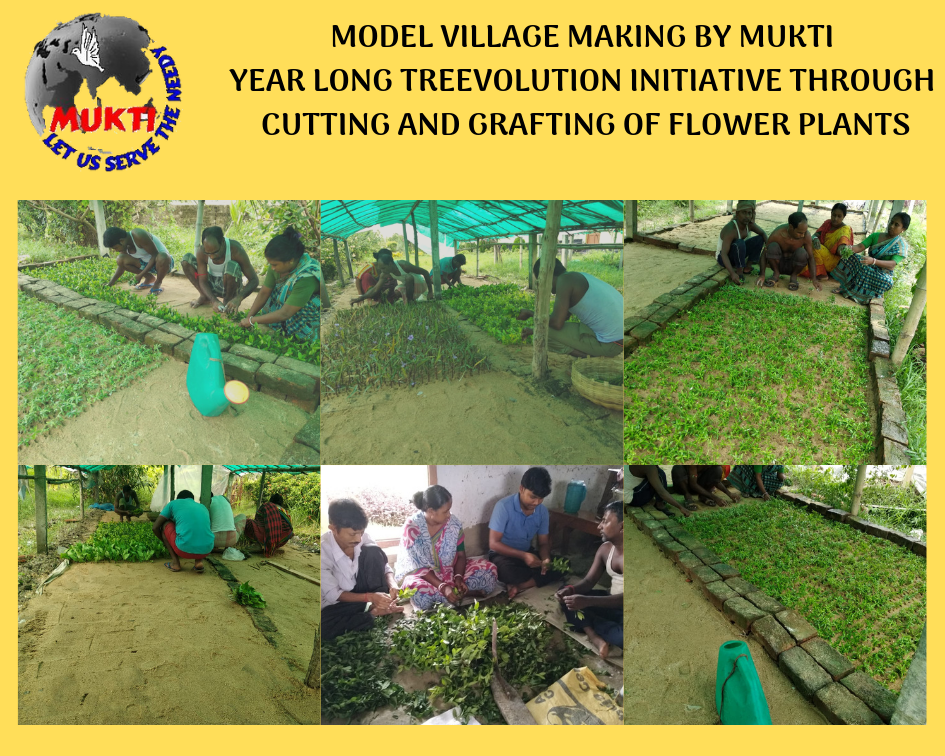
1. Yearlong treevolution initiative through cutting and grafting of flower plants.

The aim of the project is to cover entire villages with different kinds of flower plants. This initiative is done for transforming villages to eco village.
A picture containing text, grass, different, several

Description automatically generated

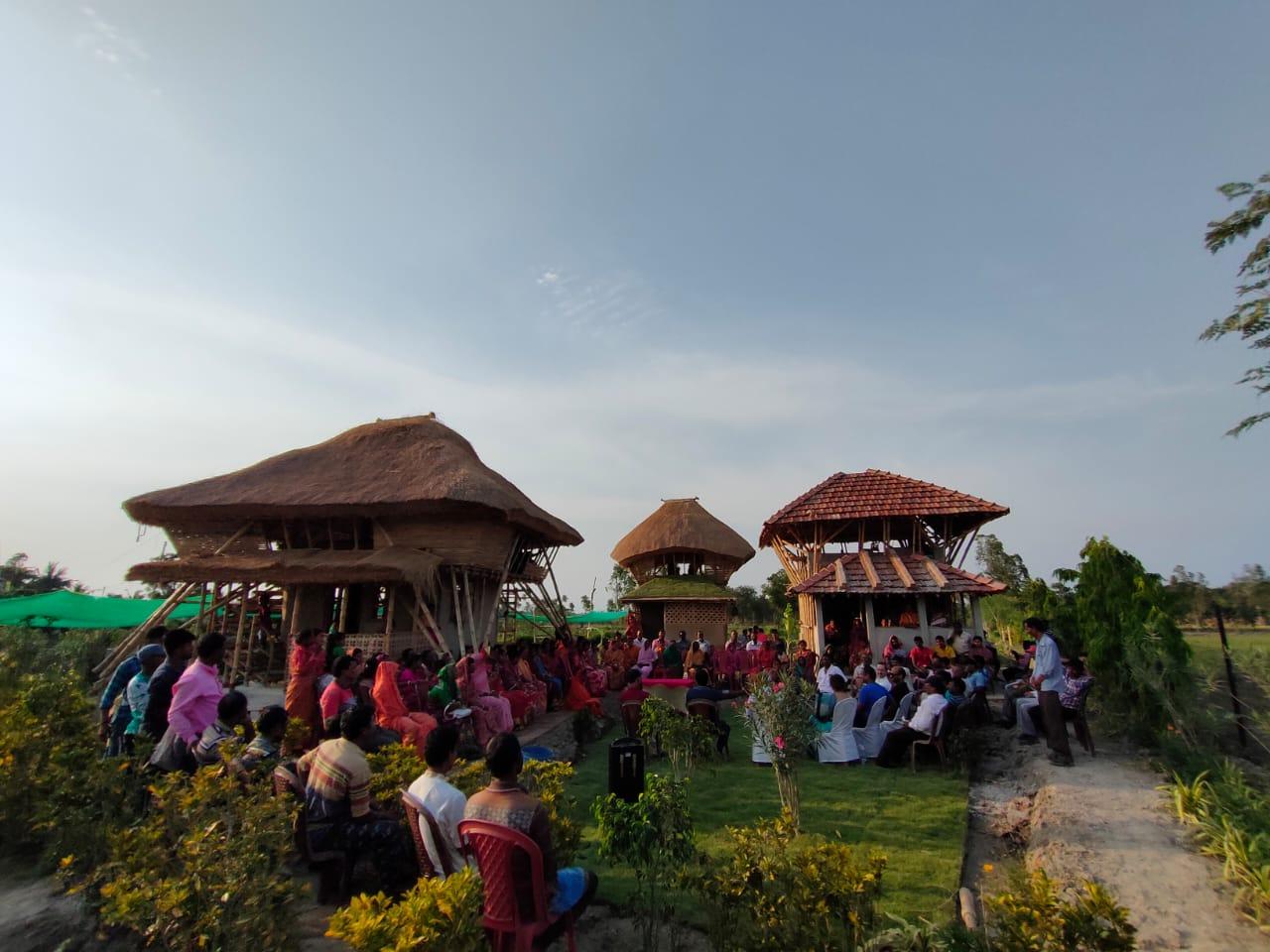
2. Construction of model houses at Mukti Gram to withstand harsh climates.

Mukti has constructed 3 cyclone tolerant houses on prototype basis under the guidance of an architectural firm. The village is prone to frequent cyclones and the impact is huge enough to affect the lives and livelihood of the community.
A group of people sitting outside

Description automatically generated with low confidence

3. Mukti Gram Clinic.

Patients are being treated by the doctors at Mukti Community Clinic at Mukti Gram. The clinic has served 1000+ patients since January through local clinic visit and 200+ patients with global panel doctors from across the globe with various specialty clinics.

President of Mukti, Mr. Sankar Halder, during an event at Mukti Gram said that, “Model village does not mean only the beautification of any village but beyond that. Money alone does not convert a village into a model village or ‘Adarsha Gram’.”

“A conceptual model village is one where villagers act as decision makers, partners and beneficiaries with multi-sectored, multifunctional and integrated development to achieve holistic and sustainable development backed up by futuristic and progressive skills leading to higher levels of productivity and improvement in overall quality of life.”

Mukti has already planted trees, installed lights on roads, made houses, created nests for birds, planted garbage bins for village beautification, created job opportunities for the villagers, built study centres for the students, built health clinic and so on.

The future

Mukti is working on building community health care centre, school, agricultural centre and many more.

Thanks to MUKTI for taking an initiative through this project and setting up an example for more of us who will march back to villages and try to make them “Sujalam Sufalam” again.

Find more about Mukti Gram here: Mukti Gram, A Modern Integrated Village | Mukti (muktiweb.org)

If you want to support MUKTI, please donate here: Donate to MUKTI causes | Mukti (muktiweb.org)


Saturday, August 20, 2011

Field survey on medical access and human trafficking in the Sundarbans

Field survey on health access and human trafficking
Kankandighi and Nagendrapur
South 24 Parganas, West Bengal
InMaLanka-Mukti
Thursday 28th and Sunday, 31st July 2011

Preamble

The inhabitants of the Sundarbans are facing difficult living conditions. Some fundamental rights are violated, including access to care, professionals and health facilities, due to bad roads, too big distance with the infrastructures and lack of money. In addition, the 2009 Aila cyclone destroyed many arable lands, which compromises the ability of families to answer their food needs. Often the girls decide to go in city, which is a less mouth to feed and future source of income for relatives. They hope to find a job but land in human trafficking networks which leads them into prostitution or forced marriage and work.

The purpose of this study is to understand the importance of these problems by the state of access to water, health facilities and understand the lifestyle and socio-economic environment in which live the women. This last point will be used to apply for the 2011Human Rights Award of the French government. Otherwise the report will be used for the project of mobile van clinic and primary cares.

The study was conducted by Aurélie Bezault, along with Bala for the translation, guided by Arabinda Mondal, a member of Mukti and coordinator of the SAM program.
The mission took place on 2 separate days, Thursday 28 and Sunday, July 21, 2011, mainly in Nagendrapur GP.
To reach this place, a train was taken from the Jadavpur Railway Station, in the south of Kolkata. After 1:15 journey, an auto-rickshaw is taken during one hour to reach Raidighi, where we have a second auto-rickshaw to reach Nagendrapur one hour later. We need a little over 3 hours to come there.


Areas studied:

24th South Parganas district
In Nagendrapur GP, the study took place in Nagendrapur and Purba Sridharpur where Mukti has an office in which could be interviewed women from a Self-Help Group.
In Kankandighi GP, the study took place at Kankandighi.


Method:
Interviews based on questionnaires prepared in advance
Meeting with a group of women, a Self-Help Group, a nurse of a Primary Health Center
Meeting with Prodhan of Nagendrapur G.P
Meeting with a woman member of the board of the Prodhan’s Council in Kankandighi GP


Details of the survey:

Thursday, July 28
The day began with an interview with a woman whose teenage daughter has disappeared. A young girl told the forced marriage of his sister. Then we had an interview with a group of women on their medical needs.

Sunday, July 30
Meeting in Kankandighi with a woman belonging to the Council of the Prodhan. Then interview of the Prodhan of Nagendrapur GP. Visit of a Primary Health Center and discussion with the Nurse. Meeting and questions with a Self-Help Group.

The objective of the study is to determine at first what are the needs of the population in terms of health and improvement of living conditions in order to respond in the future by the mobile clinic program. It was necessary to understand which diseases were most prevalent, what people wanted as common infrastructure and medicine. Special attention is given to women including the issue of pregnancy during which they remain fragile.
The second point was about the state of human trafficking, especially women in the region. These are first victims: they do not go to school after primary school, marry early to avoid paying a dowry and work very early. They hope of a better pay and living conditions in the city. Some are sold by their parents. The study wanted to understand, through interviews with authorities and victims, the mechanisms of poverty that make them the victims of human trafficking networks in order to prepare a program on the issue.

Reports by sector clusters
General data on Nagendrapur G.P

Demography
Total: 21 335
Total number of women: 10 135
Total number of men: 11 220

Security
5-6 girls are missing in the 15 villages. They are unmarried, between 16 and 20 years.
The abduction of young girls concerns very poor families whose activity does not provide sufficient income
The girls all moved on the promise of a job in the city
All did not go to school
The police is informed only at the insistence of the Panchayat (fear of corruption and lack of money, trust)
When they work, women have no safe collective place to rest
NB: During the interviews, it was said that domestic violence did not exist

Health
People wait before seeing a doctor if the healing comes by itself. Everything depends mainly on their money. They wish more modern medicine.
According to the women, they are more affected by diarrhea, asthma, fever and anemia, especially those pregnant and elderly. Muscle pain, soreness and itching are also common. During the rainy season, cough and fever affect older women.
Skin diseases are increasing.
Women give birth at home. There has been no maternal deaths for 12 years and only some premature births. Although they prefer to go to the centers, they lack of money (they blame the hospitals to have to pay for everything) and sometimes lack of time (the nearest hospital is Raidighi, 1:20 to reach it (16 km). This requires finding a means of locomotion quickly). Moreover, as women work very hard, they realize late that delivery has begun.

Women have 5 to 6 children. Their first child is born when they’re 17-19 years (depending on the women interviewed). They married between 15 and 16. The use of the pill and condoms is widespread.

Nutrition
Meals are mostly composed of rice, vegetables and fish from the pound.
During pregnancy, women do not have particular dietary or nutritional supplement. They take iron tablets and have injections against tetanus.
They are breastfeeding for 6 months.
Children at birth weigh between 1.5 and 2 kg
Women state that they have little food and difficulties in feeding their children

Water, hygiene, sanitation
The tubes are not in good condition and do not work 24/24. The water contains impurities: the non-clean water is the cause of many diseases affecting people.
- 1 / 3 of the population does not have private latrines (on 30 000 people, nearly 2,000 families involved)
There is no collective sanitation
Women need to walk 10 minutes to go relieve himself. They go into the woods or fields, only even if it is risky.
Women wash twice a day at the pond with soap purchased in town
During their periods, they use a towel they have made themselves but that are not properly cleaned. This causes itching, the appearance of viruses. Women don’t understand where it comes from.
- The waste is buried, thrown everywhere. There is no place for this purpose. Some people recover it as fertilizer for the fields. Nothing is burned and the plastic is a problem.

Education:

97% of children attend (mandatory). 80% goes to the 8th standard and 40% until 10th standard
2 High School, attended by 10% of students (250 children)
Most girls stop their education after primary school (compulsory) to work with their parents.

Some married too young, because then there is no dowry demanded. Most left school at 15 because the family cannot pay (Legal age in India: 18 years).

Socio-economic, livehood
Women's SHGs grow coconut and breed exotic birds
Most houses have walls of clay and a thatched roof
The animals live near homes or in the yard
Poverty of the people whose activity is not sufficient to enable them to live

General data on Kankandighi G.P

15 villages

Demography

Total: 21 824
Total women: 10 417
Total men: 11,407

Security
No cases of missing woman
An NGO has campaigned against human trafficking

Water, hygiene, sanitation
A tube-well for about 350 people
The pipes are in poor condition and are often broken
The water tube is not sufficient for daily life so the vegetables for the meals are washed in the pound
There is no private latrines in most homes and there is no common health infrastructure
-The waste is deposited in a large container and a few days later recovered as fertilizer. The plastic is burned, causing respiratory problems.

Education
11 primary school
1 Governmental High School
2 Governmental Secondary School
A school up to 8th standard and led by an NGO
2 Child Education Center
70% of children go to school

Health
The nearest hospital is the Raidighi (4 km): Many women will give birth there even if the beliefs, superstitions make that the home is preferred to give birth
The most common health problems are fever, cough, diarrhea, colds, stomach acid and pains
The hepatitis B is increasing (5 / 100)
Cases of depigmentation are more frequent (parasols and sun lotions are expensive)
90% of people are not aware of health problems, immune system and health

Socio-economic and livehood
30% of farmers (Main industry: Agriculture)
Most houses are built of clay and a thatched roof.

General recommendations by clusters

Security
Organize awareness campaigns for parents and children (what procedure?)
Workshops on women's rights, AIDS
Create groups of women to ensure the movement and why not build a place where they can rest, provided with health facilities where they can go not far from the field?
Train the police to offer effective, listening and following the procedures in case of disappearance

Create a warning board about women trafficking at the entrance of the road of the Sundarbans


Water, hygiene, sanitation
Organise regular audits and reviews of the status of the tubes and water quality
When the tubes are bad, replace them with more modern so as not to have a series of failures in the long-term
Offer at least a set of communal latrines per village
Building private latrines for those who request
Organize a campaign to boil water and the importance of washing hands regularly
Create one place in each village where waste is stored, destroyed or burned
Awareness about the dangers of plastic for the environment (including land and water)

Health
Provide basic medicines to treat diarrhea, fever, cough and asthma

Assure a medical follow (especially for asthma)
A prevention campaign about prolonged sun exposure and its consequences
Build a clinic with beds and professional equipment. Staff of the Medical University?
Provide ambulance service
Provide food supplements to pregnant women until the end of breastfeeding
Finance a vaccination campaign against hepatitis B?
Make a campaign of information on genital diseases and how to prevent them

Nutrition
Create a garden with vegetables at school, administrated by the kids themselves
Identify families in great difficulties and assist them to feed the relatives

Education
Create a specific program on girls' education (scholarship system for them to continue their education until 18 then TSS)
Form some girls to trades (hairdresser? Nurse?) A useful job for the locals

Livehood
Diversify the activities of SHGs: women ask for more aid to have domestic animals (cows) so that each home has its own farm (chicken, duck, goat).
Develop the activity of weaving (local specialty) or manufacturing paper bags

Conclusion
While living in the Sundarbans is already difficult environmental conditions and climate, the inhabitants suffer from more difficult access to care and medical staff. This is a vicious circle because people, especially women, if they are sick, are not capable of ensuring their work, therefore, can’t earn money and feed their families as needed. The mobile clinic project must meet the needs of these women, longing for such an initiative.
In addition, we can also provide structures improving the lives (and health) of people, including a system of latrines.
It appears that one of the priorities is to ensure education for all, especially girls so that they remain in control of their future and a job as a domestic in the city is not a lure to help financially their families.
The SHG project should also be extended to other women and offer other activities. It is the wish of the participants because they recognize an improvement in their financial situation.